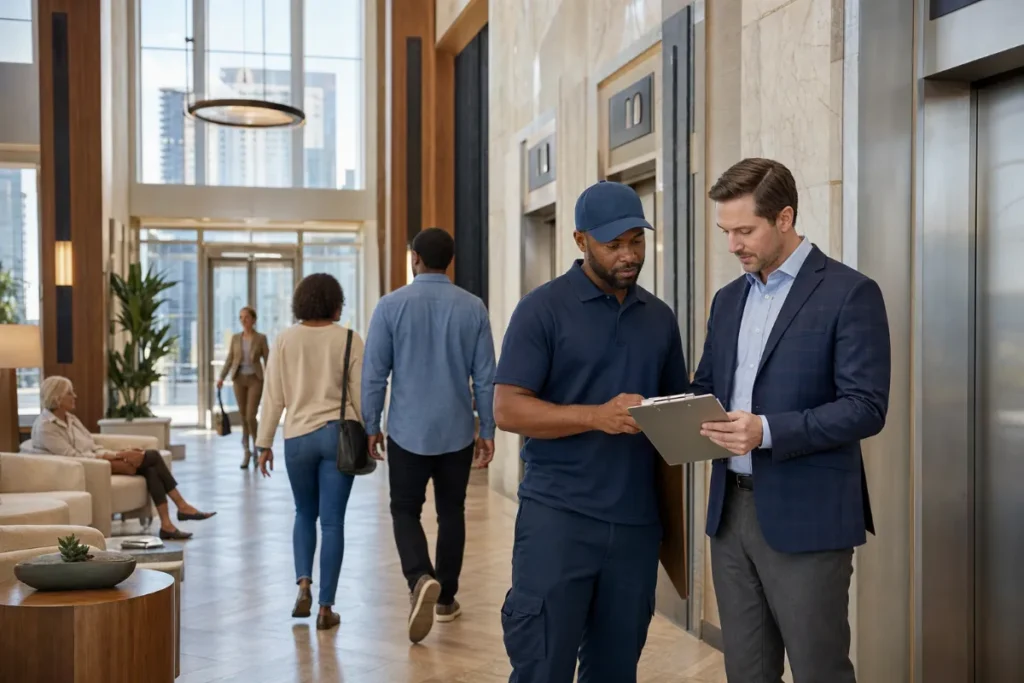
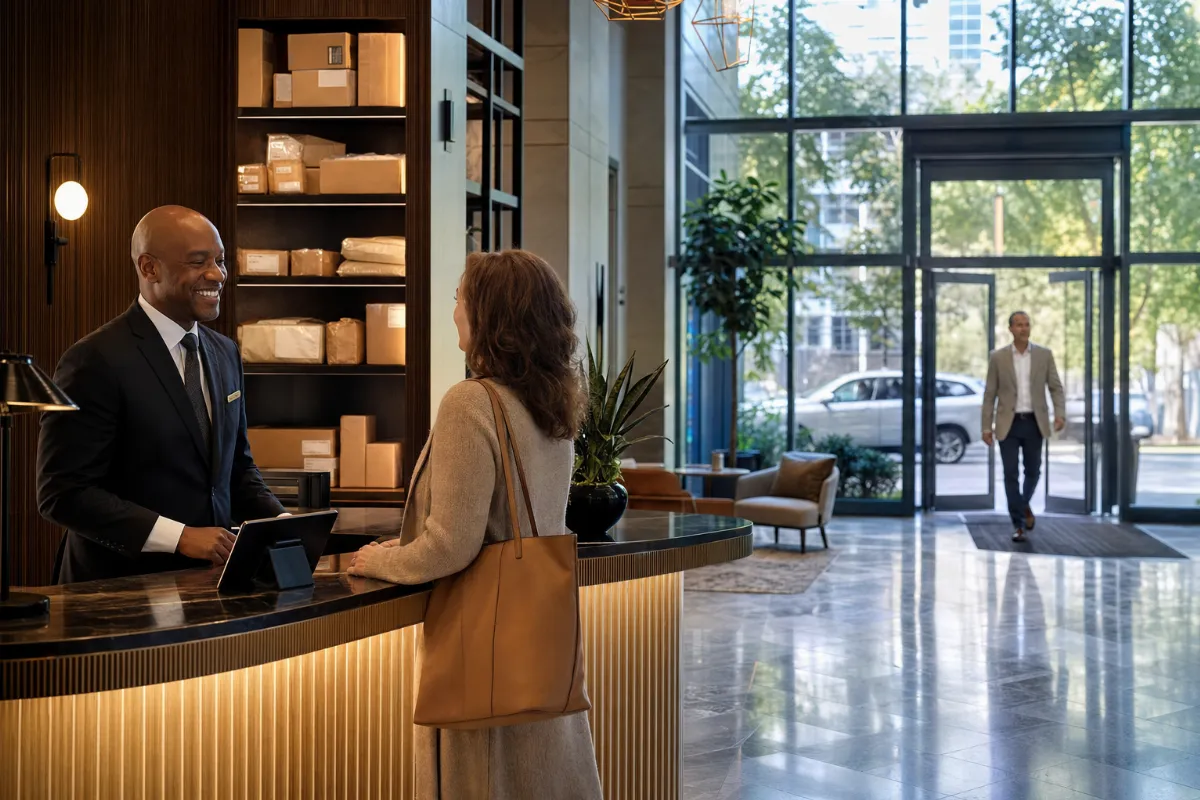
For a Nashville high-rise association, the question “what should condo concierge services include?” is really a question about daily operations, resident trust, access control, and board oversight.
A concierge team is often the first human contact residents, guests, vendors, delivery drivers, real estate agents, and emergency responders have with the building. That makes the role important, but it also means the board should define the job carefully instead of assuming “front desk help” means the same thing to everyone.
Quick answer: Condo concierge services typically include front desk coverage, resident and guest assistance, visitor verification, access coordination, package intake and release, amenity reservations, service request routing, incident documentation, and emergency communication support. The board should document these duties in post orders, service standards, escalation procedures, and management reporting so concierge staff support the community without replacing board governance, licensed security, or professional management.
Why Concierge Scope Matters in Nashville High-Rise Communities
In a high-rise condominium, the front desk is not just a lobby feature. It is an operating point where resident service, building access, deliveries, amenities, vendors, emergency information, and daily communication meet.
That is why scope matters.
If the board leaves the role vague, concierge staff may be pulled in too many directions. One resident expects hotel-style personal assistance. Another expects security screening. A vendor expects immediate building access. A board member expects policy enforcement. Without clear written standards, the desk can become inconsistent, overextended, or exposed to avoidable disputes.
Condo board member responsibilities also matter here. Tennessee condominium law generally places responsibility for maintenance, repair, and replacement of common elements on the association unless the declaration or specific statutory provisions say otherwise. The language appears in Tennessee Code section 66-27-407. The concierge desk does not create that responsibility, but it often receives the first report when a common area door, elevator, leak, odor, amenity, or access point needs attention.
Nashville buildings also operate within local property standards. Metro Nashville states that property areas are to be maintained in a safe, clean, and sanitary condition under its property maintenance code guidance. For a board, this reinforces the need for a front desk process that records issues and routes them to management or maintenance instead of leaving them as informal hallway conversations.
The practical takeaway is simple: concierge service should be warm and helpful, but it also needs structure.
What Should Condo Concierge Services Include?
Concierge services for condos in Nashville will vary by building size, staffing model, budget, amenity package, and resident expectations. A tower with a staffed lobby, package room, access-controlled elevators, guest parking, move-in coordination, and multiple amenity spaces needs a more detailed plan than a smaller building with limited desk hours.
Most high-rise associations should expect the concierge function to address these areas:
Front desk presence and resident greeting
Guest and visitor verification
Package and delivery handling
Access credential support and escalation
Vendor check-in and service coordination
Amenity reservations and common area information
Resident request intake and routing
Incident logs and shift handoff notes
Emergency communication support
Service standards for tone, discretion, and consistency
The best programs do not treat these as separate tasks. A package issue may reveal an access-control gap. A guest complaint may point to unclear resident authorization rules. A recurring vendor question may show that post orders are incomplete. The concierge desk should help management see those patterns.
1. Front Desk Presence and Resident Support
The most visible concierge responsibility is front desk presence. Residents and guests should know where to go, who is on duty, and what the desk can help with.
Front desk support may include greeting residents and guests, answering routine building questions, directing visitors, receiving calls, providing move-in instructions, explaining amenity reservation procedures, and helping residents understand where to submit maintenance or management requests.
Boards should define the tone of service. In a luxury high-rise, residents usually expect professionalism, discretion, calm communication, and consistency between shifts. That does not mean every request should be granted. It means the answer should be accurate, courteous, and aligned with the association’s rules.
A good standard is this: the concierge should be helpful without improvising policy.
For example, if a resident asks whether a guest may use an amenity without the resident present, the concierge should follow the building’s written rule. If a resident asks for an exception, the issue should be routed to management under the board-approved process.
2. Guest, Visitor, and Access Coordination
Visitor handling is one of the most important parts of high-rise front desk work. It affects resident privacy, building security posture, and the overall feel of the lobby.
Concierge staff may help verify guests, check visitor lists, call residents for approval, issue temporary access permissions where authorized, track vendor arrivals, and direct visitors to the correct elevator, parking, loading area, or amenity space.
Access control should be documented. CISA’s physical security guidance recommends limiting access to authorized visitors, considering visitor management systems, and maintaining access controls for critical areas in its physical security performance goals. A condominium is not a federal facility, but the principle is useful: access should be intentional, recorded where appropriate, and tied to a clear authorization process.
Boards should be especially careful with master keys, fobs, elevator access, package rooms, mechanical rooms, and residential floors. The front desk should not rely on memory, personal familiarity, or pressure from a resident or vendor when the written process requires approval.
Post orders should answer:
Who may authorize a visitor
How authorization is confirmed
Whether guests receive temporary credentials
What information is logged
What happens when a resident cannot be reached
Who may access restricted areas
When staff should contact management, security, or emergency services
Access control is where hospitality and discipline have to work together. A courteous desk that waves people through without authorization is not serving the association well.
3. Package and Delivery Handling
Package handling is often one of the busiest concierge duties in a high-rise building. It also creates some of the highest resident frustration when expectations are unclear.
A concierge package process should define what the desk accepts, how deliveries are logged, where packages are stored, how residents are notified, who may pick them up, and what happens with oversized, perishable, damaged, leaking, or misaddressed deliveries.
Mail and package security is a real operating concern. The U.S. Postal Service Office of Inspector General describes national efforts to reduce mail theft through Project Safe Delivery. For condo associations, the lesson is not that a concierge can prevent every loss. It is that package flow needs a controlled process, especially during high-volume periods.
Boards should avoid vague promises such as “the desk handles packages” without defining what that means. A better policy addresses:
Carrier delivery location
Package scanning or manual logging
Resident notification method
Identification or authorization required for pickup
Pickup by family members, guests, assistants, or housekeepers
Oversized deliveries and furniture
Food, alcohol, medication, and temperature-sensitive items
Unclaimed package procedures
Loss, damage, and misdelivery reporting
Package handling also needs space planning. If the package room is too small, poorly organized, or open to too many people, even good staff may struggle. The board may need to pair concierge procedures with building maintenance, access control, signage, shelving, cameras, or package room improvements.
4. Service Requests, Vendors, and Maintenance Routing
Concierge staff should not replace the community manager or maintenance team. They can, however, make both functions work better by capturing information accurately and routing it to the right place.
Common examples include elevator complaints, common area spills, hallway odors, garage gate problems, access-card issues, amenity damage, noise reports, water intrusion, and vendor arrival questions.
A strong concierge process tells staff what to record:
Date and time
Resident name and unit, when applicable
Location of the issue
Description of the concern
Immediate action taken
Who was notified
Whether follow-up is needed
This documentation gives Nashville condo boards better records to review. It also helps connect the front desk to building maintenance services, because recurring reports may point to a larger repair, preventive maintenance item, vendor issue, or capital planning question.
Vendor coordination should be just as clear. The desk may check vendors in, confirm a work order, notify management of arrival, issue temporary access where approved, coordinate loading dock or elevator use, and record departure. The concierge should not approve scope changes, negotiate pricing, or authorize work unless the board and management agreement specifically allow it.
5. Emergency Communication Support
High-rise buildings need calm, accurate communication during urgent events. Concierge staff are often near the lobby, phones, radios, visitor logs, elevators, and resident traffic, so they may play an important support role.
That role should be written before an emergency occurs.
NFPA explains that high-rise buildings present unique life-safety challenges, including longer egress times, fire department access, smoke movement, and fire control, in its high-rise building safety resources. The U.S. Fire Administration also publishes high-rise apartment and condominium fire safety guidance for residents.
For concierge teams, the board should define emergency support duties such as:
When to call 911
Who receives internal notifications
How to communicate with residents during building incidents
Where emergency contact lists are stored
How to assist first responders with building information
How to document incident timelines
What staff should not say or promise during an active event
Concierge staff should not be asked to make technical life-safety decisions that belong to first responders, qualified vendors, management, or the board. Their job is to follow the emergency procedure, communicate through approved channels, and document what happened.
6. Concierge, Security, Management, and the Board Are Different Roles
One common mistake for Nashville high-rise boards is blending several roles into one front desk position.
A concierge team can support access control and incident reporting. That does not automatically make the team a licensed security provider. Tennessee Private Protective Services regulates armed and unarmed security guards, certified trainers, contract security companies, and proprietary security organizations under Tennessee security licensing requirements. Boards should review those rules with counsel or qualified providers if they want staff to perform security guard or patrol functions.
The distinction matters for training, contracts, insurance, resident expectations, and liability.
| Role | Typical focus | What the board should document |
|---|---|---|
| Concierge team | Resident service, guest coordination, package handling, amenity information, request intake, and shift logs | Post orders, service standards, escalation steps, package rules, visitor procedures, and reporting expectations |
| Security provider | Security guard duties, patrols, incident response, access enforcement, and protective services where properly licensed | Licensing, scope, patrol duties, incident response limits, coordination with concierge, and emergency protocols |
| Community manager | Association operations, board support, vendor coordination, communications, contracts, and administrative follow-up | Management agreement, approval authority, communication process, reporting cadence, and board packet content |
| Board of directors | Governance, policy, budget approval, rule adoption, contracts, oversight, and fiduciary decisions | Governing documents, board resolutions, budgets, service level expectations, and decision authority |
CAI’s governance materials describe guidelines intended to help board members and community leaders create and sustain effective communities. Boards can use CAI’s homeowner leader resources as a helpful reference when separating board oversight from daily staff work.
For a Nashville condo board, the goal is not to make the concierge team do everything. The goal is to make sure each role knows what it owns, what it escalates, and what it documents.
What Should Be in Concierge Post Orders?
Post orders are the written operating instructions for the concierge position. They should be specific enough that a trained employee can work the desk consistently, even if the regular lead concierge is out.
Post orders should be reviewed by management and the board, and they should be updated when rules, systems, vendors, building access, amenities, or staffing hours change.
A practical post order set should include:
Desk hours, shift times, and coverage expectations
Opening, closing, and shift handoff procedures
Resident greeting and phone standards
Visitor verification and guest access steps
Package intake, storage, notification, and release procedures
Key, fob, elevator, and access credential procedures
Move-in, move-out, loading dock, and delivery procedures
Amenity reservation and rule references
Vendor check-in and contractor access requirements
Emergency contacts and escalation steps
Incident reporting and documentation standards
Privacy, resident information, and discretion expectations
Items the concierge is not authorized to do
The last item is important. Post orders should clearly state limits. For example, concierge staff may not enter a unit without written authorization under the association’s policy, release a key to an unauthorized person, approve contractor work, waive rules, accept cash or gifts if prohibited, disclose resident information, or make legal interpretations for residents.
Steps for Boards Considering Professional Concierge Management
A Nashville high-rise association should consider professional concierge management when the front desk has become too complex for informal oversight, when resident expectations are inconsistent, or when the board wants stronger documentation and supervision.
Use these steps before changing the service model:
Review the governing documents and current rules. Confirm what the association can regulate, what the board has already adopted, and where policies need clarification.
Map the current desk workload. List every task the desk performs in a normal week, including packages, guests, calls, move-ins, vendors, amenities, incidents, and resident questions.
Identify risk points. Look for weak spots in package release, key handling, visitor access, resident privacy, after-hours escalation, and emergency communication.
Define service levels. Decide the hours, tone, response standards, reporting cadence, and scope the association is willing to fund.
Create or update post orders. Put the daily process in writing, including what staff should do and what they should escalate.
Align concierge with management and maintenance. Make sure requests move from the desk to the correct person or system, not to a board member’s personal phone.
Measure performance. Review logs, resident feedback, unresolved issues, staffing coverage, and recurring problems at regular intervals.
These steps help the board move from personality-based service to process-based service. That is especially important for Nashville community associations where residents expect both hospitality and fairness.
How Stratus Management Helps Nashville High-Rise Boards
Stratus Management is a residential property management company in Nashville, Tennessee. We manage condominium and homeowners’ associations, with a focus on high-rise and luxury residential buildings.
For boards reviewing concierge services, our Concierge Management Services page is the best next step. Concierge management connects the front desk experience with resident support, access coordination, package handling expectations, communication, and the broader operating needs of the building.
Concierge service also works best when it is not isolated from the rest of management. Boards may need front desk procedures tied to association management, maintenance routing through building maintenance services, financial planning through HOA accounting services, and resident communication through resources for residents.
If your board is comparing providers or reworking an existing front desk model, you can also request a management conversation through Get Proposal.
When a Concierge Program Is Working Well
A strong concierge program feels calm from the resident side because the process behind it is clear.
Residents know how guests are handled. Packages are logged and released consistently. Vendors know where to check in. Staff know when to escalate. The board receives useful information instead of scattered anecdotes. Management can see patterns and follow up. Rules are applied with courtesy, not guesswork.
That is the standard Nashville condo boards should expect. The concierge team should make the building feel more organized, more welcoming, and easier to operate, while still respecting the limits of the role.
If your board is asking what should condo concierge services include and wants help structuring front desk expectations for a Nashville high-rise community, contact Stratus Management through our Contact Us page.